
Kennesaw, GA · Garage Door Service
What Makes an Older Garage Door in Kennesaw Worth Repairing
Most Kennesaw garage doors date to 1970-2007, so many are still worth repairing rather than replacing. Here's how we weigh an old door's condition and cost.
- Repairs & new doors
- Springs & openers
- Serving 6 nearby communities
Leaving It Alone
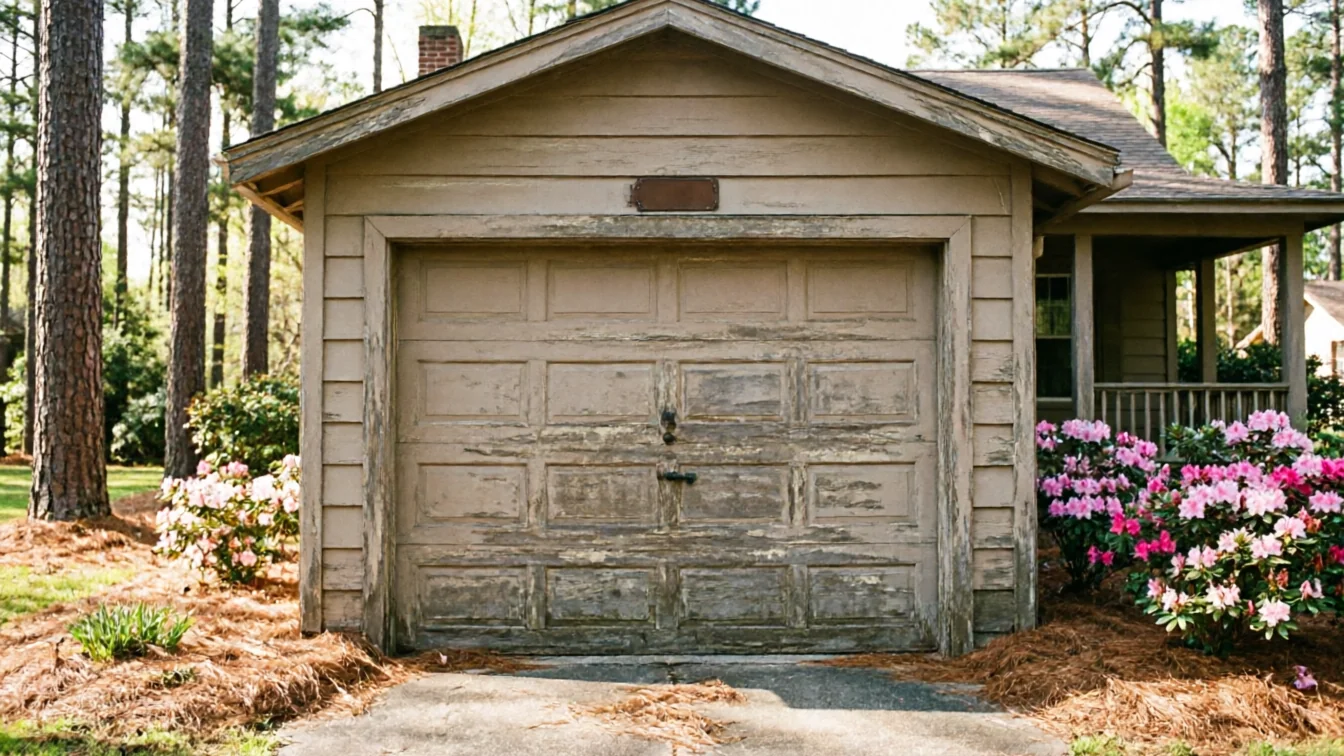
If your door still opens smooth, closes square, and the opener doesn't grind or hesitate, leave it alone. A lot of what we get called out for in this area isn't failure - it's a homeowner assuming a door built in the early 1990s must be due for something. Houses in this service area were mostly built between 1970 and 2007, with the typical build year landing around 1992, so a thirty-year-old door is normal here, not a red flag.
The parts that matter are the moving ones: springs, rollers, the opener's drive gear. If those are sound, a dated panel design or a faded color isn't a reason to spend money. We'll tell a homeowner their door is fine even when they called expecting bad news, because a service call that ends in "nothing to fix" costs us nothing and costs them fifteen minutes. Chasing cosmetic age on a mechanically healthy door is the most common way people overspend on this job.
The Situation
Across the service area, housing stock runs 1970 through 2007, and most of what we work on falls into the 1980s and 90s band - original torsion springs, first- or second-generation chain-drive openers, steel panels from before insulated doors were standard. That's consistent across roughly ten distinct pockets of the area, not just one subdivision, which means the repair-versus-replace math is similar whether you're near the center of town or out toward the edges.
With close to 15,600 owner-occupied houses among the area's roughly 37,000 households, a large share of the doors we see share a birth decade. That's useful: it means parts for a 1990s torsion setup are still something we stock, because we replace them often enough. It's the doors outside that window - either much newer with proprietary opener electronics, or the rare holdout from before 1970 - where parts get harder to source and the repair math shifts toward replacement faster.
How Local Conditions Play In
This area sits in a cold-moderate climate band - real winter cold, but not the deep-freeze extremes that crack steel outright. What that does to an older door is slower and sneakier: freeze-thaw cycling works bolts loose, hardens old lubricant in the torsion spring coils, and lets humidity swings warp wood trim pieces that were common on doors from the 1980s and 90s.
So the failure pattern on an older Kennesaw-area door usually isn't a dramatic snap. It's a spring that's lost tension gradually, a track that's walked slightly out of alignment over a couple hundred freeze-thaw cycles, or a panel seam that's started separating where moisture got behind the paint. None of that means replace the door - it means service the hardware before the slow wear turns into a cable off the drum or a spring that lets go under load. Catching it at the loose-bolt stage is cheap. Catching it after a full spring failure usually isn't.
What You Pay
With a median household income of $82,014 across the service area, most homeowners we talk to are comparing a repair bill against a full replacement, not deciding whether to do anything at all. For a door from the 1980s-90s stock that's still structurally square, repair almost always wins on cost - new springs, rollers, or a cable run on an otherwise sound door is a fraction of a new installed system.
Where it flips: if the panels are rusted through at the bottom, or the track is bent beyond a cold-weather tune, you're paying repair money toward a door that'll need the same call again in a year or two. We'll say so plainly rather than patch something twice. One honest limit - some opener models from this era used proprietary logic boards that are discontinued, and if yours is one of them, we're not going to pretend a part is coming when it isn't. That's a replacement conversation, not a repair quote.
Frequently asked questions
Is my garage door too old to repair?
Age alone doesn't decide it. A door from the 1980s or 90s that's still square and moving smoothly is almost always worth repairing - springs, rollers, and cables are standard parts for that era. It's rust-through panels, a badly bent track, or a discontinued opener control board that push the decision toward replacement instead.
Why does my door act up more in winter?
This area's cold-moderate climate means freeze-thaw cycling, not deep-freeze extremes. Over years, that works bolts loose and stiffens old lubricant in the spring coils rather than cracking anything outright. It shows up as a door that's slower or noisier in winter, which is usually a hardware service issue, not a sign the door itself has failed.
How do I know if it's the spring or the opener?
If the door is heavy to lift by hand with the opener disconnected, that's spring tension, not the opener. If the opener runs but the door doesn't move, or moves and reverses, that's drive gear or the opener's logic. We check both before quoting, since replacing one when the other is the problem wastes your money.
Do you ever recommend against repairing an older door?
Yes. If the panels are rusted through at the base or the opener uses a discontinued control board, we say so rather than sell a repair that won't hold. That's a smaller share of what we see, since most of the area's doors date from 1970 to 2007 and still have available parts, but it does happen.
Related garage door services in Kennesaw
More garage door guides
Book garage door service in Kennesaw
Call now or request a quote - tell us what the door is doing and where you are.